
Most organizations meet generative AI through a window: a chat box, a document assistant, a search field, a button labeled “summarize.”
The window is useful. It is also misleading.
It makes the model look like the product and everything around it look like integration work. In practice, the durable product is the layer that decides what the model may see, what it should remember, which work belongs to whom, what it may propose, what it may change, and how the organization will know the change actually happened.
That layer is a control plane.
Without it, a company can connect more data and become less certain. The system is capable of reading everything, but nobody knows what is fresh. It can infer a task from a conversation, but nobody verified the owner. It can draft and send, but the approval boundary is an instruction in a prompt. It remembers, but nobody can distinguish a durable decision from an old summary.
Capability expands faster than trust.
The integration fallacy
The most intuitive AI roadmap is additive:
- connect email;
- connect documents;
- connect tasks and calendars;
- connect customer and financial systems;
- let the model reason across them.
Every connector appears to make the assistant smarter. Every connector also introduces a new failure mode.
Was the pull complete? Which identity authorized it? Is the local cache current? Does an empty result mean nothing exists, the filter was wrong, or access expired? Did the record originate in the source or in an earlier model summary? Is the data informative, actionable, or prohibited from influencing this workflow?
The problem is no longer access. It is governed interpretation.
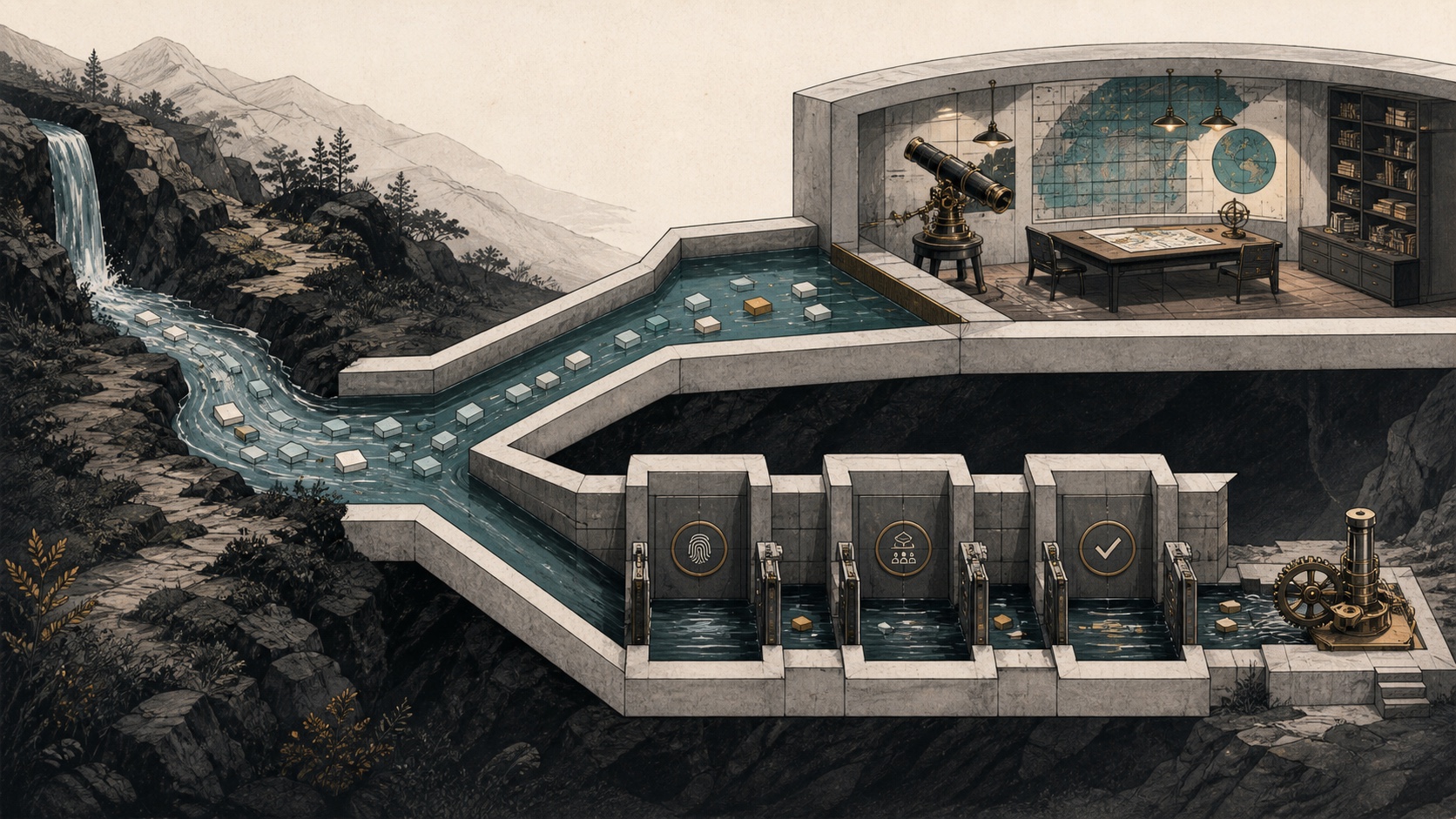
A control plane answers that problem through six services around the model.
1. A sensing layer that represents uncertainty
Business data should enter through narrow adapters with explicit contracts. Every observation needs more than a value. It needs an envelope:
- source and account identity;
- source event time;
- observation time;
- synchronization status;
- freshness expectation;
- completeness or pagination state;
- permission state;
- provenance reference.
This allows the system to distinguish several states that dashboards often collapse:
- connected but stale;
- authenticated but unauthorized for this record;
- successful query with no results;
- partial ingestion;
- malformed source data;
- source unavailable;
- current observation.
Uncertainty must survive into the user experience. If a weekly briefing is missing one source, it should say so. If a task recommendation depends on old data, the age should travel with the recommendation.
“I do not know because this source has not synchronized” is operational intelligence. A polished answer built on silent staleness is not.
2. Memory that belongs to the business
Chat history is an interaction log. It is not organizational memory.
Useful memory should remain portable across models and interfaces. It should preserve what happened, why it mattered, where the fact came from, and whether it is still valid.
A practical memory layer distinguishes:
- facts;
- decisions and their rationale;
- constraints;
- people and relationships;
- open obligations;
- completed outcomes;
- preferences inferred from repeated behavior;
- source observations that have not earned durable status.
Raw activity should not become permanent truth automatically. Repetition can be compressed. Short-lived events can expire. Contradictions should remain inspectable rather than being overwritten by the newest fluent summary.
Retrieval should work like paging, not flooding. Bring the smallest relevant state into the model for the current task. Keep the rest outside the context window.
This creates a strategic asset that does not depend on one vendor’s chat transcript. The model can change. The organization’s memory remains.
3. Two lanes: intelligence and obligation
This is the separation most AI productivity systems miss.
An agent reads a group conversation and identifies an important topic. The topic belongs in a briefing. Downstream, a second process sees the same text and turns it into a task assigned to the person who happens to be reading it.
Information has silently become responsibility.
A control plane keeps two lanes.
The intelligence lane asks:
- Is this fresh and credible?
- Is it relevant to a verified project, customer, or risk?
- Does it add something not already known?
- Is it worth one of a limited number of attention slots?
The obligation lane requires a higher standard:
- Is there a direct request or established responsibility?
- Is the owner explicit?
- Is the obligation still open?
- Has it already been handled elsewhere?
- What event makes it urgent?
- What evidence supports the next step?
Intelligence can inform a decision. It cannot, by itself, create a task, notify someone urgently, or authorize an external action.
This is more than data hygiene. It protects people from an AI system that converts every mention into work and every signal into interruption.
4. An attention contract, not a larger inbox
Many “AI cockpits” aggregate feeds and call the result focus.
If five streams become one infinite stream, the company has centralized the noise. It has not reduced it.
An attention contract defines scarcity deliberately. A daily operational view might allow a fixed number of decisions, risks, and unresolved obligations. Items compete based on freshness, materiality, ownership, and change since the previous view. The system records what was admitted, what was suppressed, and why.
This matters because attention is one of the most expensive resources in an organization. A cheap inference that causes ten unnecessary reviews is not cheap.
Tasks also need a lifecycle. A trustworthy queue records:
- owner;
- evidence;
- requested outcome;
- current state;
- urgency reason;
- next step;
- approval requirement;
- deduplication identity;
- completion or dismissal receipt.
The queue should reconcile the same obligation across sources. Three reminders about one responsibility are not three tasks.
5. Authority that is specific and earned
An agent’s ability to act should not be inferred from its ability to read.
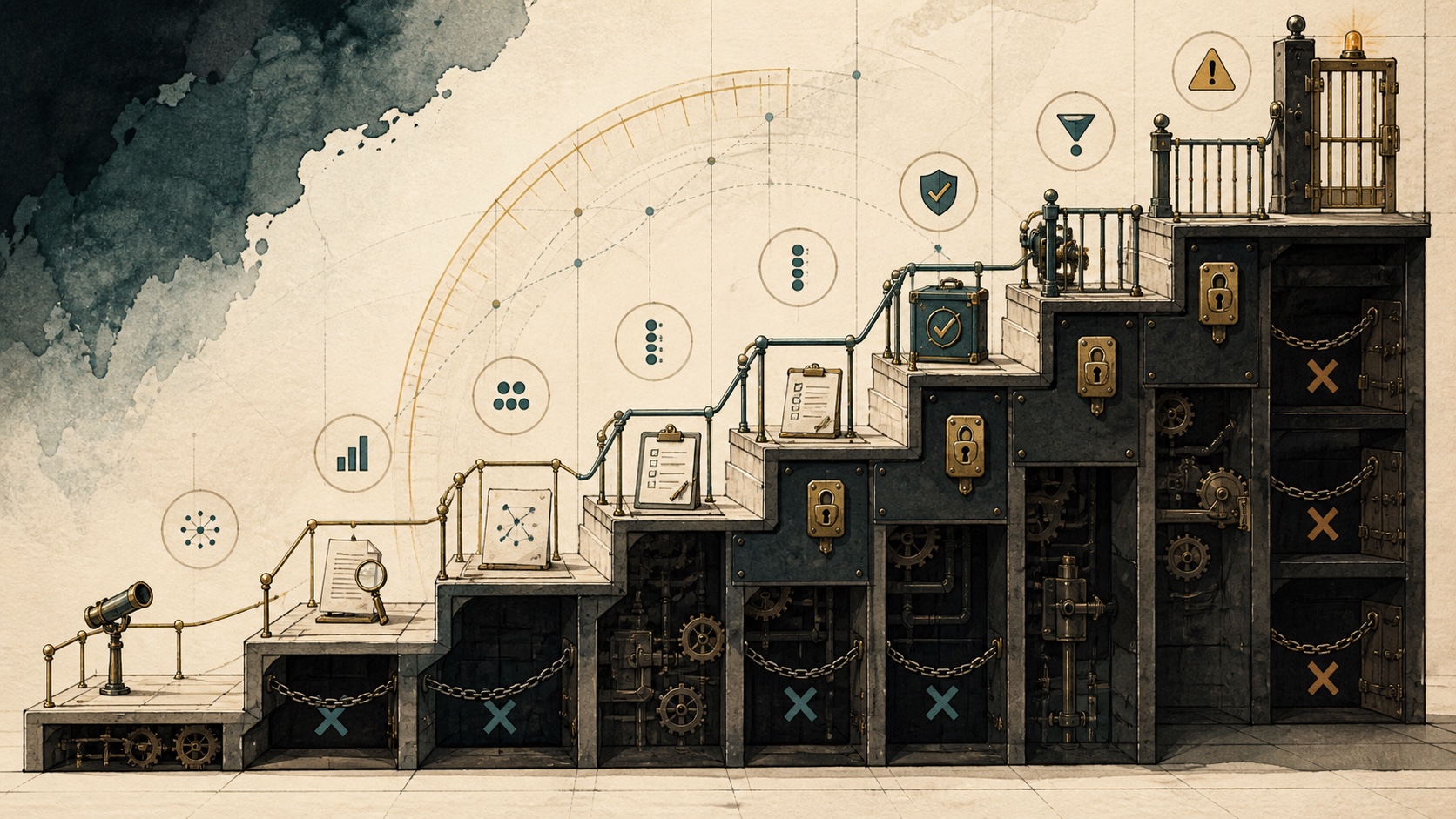
Authority can be organized as a ladder:
- observe;
- summarize;
- recommend;
- draft;
- execute after approval;
- execute within a narrow policy;
- handle a defined exception or escalate.
The system can occupy different rungs for different action classes. It may autonomously tag an internal record, draft an external message for review, and be entirely unable to delete data.
Every consequential action should carry the plan, expected impact, approving identity when required, idempotency key, execution result, authoritative read-back, and audit receipt.
This is how autonomy grows responsibly: not because the model became more persuasive, but because a bounded behavior accumulated evidence of reliability.
6. A diagnostic layer that tests the journey
Infrastructure health is necessary and insufficient.
A source process may be running while its token is expired. A backend may return success while the interface is blank. A write API may accept a request that never appears in the system of record. A mobile workflow may fail only on a real network transition.
The control plane needs a diagnostic layer that follows the user’s critical journey:
source → freshness → memory → policy → task state
       → approval → action → authoritative read-back → user surface
Each probe should produce immutable evidence, recognize recovery, and distinguish a new incident from a repeated symptom. When a capability cannot be attested, the system should fail closed rather than infer health from neighboring components.
The principle is simple: the operation is healthy only when the intended journey works.
Learning without creating a black box
A useful system should improve with use. An opaque profile that silently absorbs every click is not the only way to learn.
Use two speeds.
Fast operational learning can record explicit local facts: the item was handled, these signals refer to the same obligation, this source is stale, this suggestion was dismissed for now.
Slow policy learning requires repeated evidence: several edits indicate a communication preference; repeated rejections suggest a relevance rule; a specific action class has succeeded often enough to consider a narrower approval policy.
Promotion into durable memory should be inspectable. Deletion should be possible. Moving a private fact into shared context should be explicit. Learning should leave receipts.
The system should become more useful without becoming less legible.
Higher stakes require smaller claims
As the domain becomes more consequential, fluent inference becomes less acceptable.
In financial, legal, personnel, or health-related work, preserve source boundaries and chronology. Use domain-specific pipelines and language constraints. Allow minimal derived signals to cross into a general workflow, with methodology and evidence attached. Do not let a general-purpose memory blend sensitive records into an untraceable profile.
The right output is often a careful question or a flagged discrepancy—not a conclusion.
The more serious the consequence, the more the system should reveal what it knows, how it knows it, and where it stops.
Why this architecture survives model churn
Models will become better planners. Tool protocols will change. Interfaces will move. Local inference will improve. Some of today’s agent frameworks will disappear.
A control plane creates stable seams:
- models reason but do not own memory;
- adapters connect but do not define truth;
- policies are versioned outside prompts;
- tasks survive agent sessions;
- evidence contracts survive interface changes;
- clients consume canonical work state;
- evaluations pin user-visible behavior;
- authority remains explicit.
This is why the hidden product matters. It preserves the business while the AI layer evolves.
The companies that get durable value from agents will not be the ones that connected the most systems first. They will be the ones that learned to control the passage from evidence to attention, from attention to responsibility, and from responsibility to action.
The model participates in that passage. The control plane makes it trustworthy.
Pyranthus assembles this control layer around one repeated task: source evidence, portable memory, human checks, working automation, and a handoff runbook. Bring us a workflow.